
Ceiling Water Damage Repair in Greenville, SC
Water stain spreading across your ceiling? Dripping, bulging, or sagging? We find the leak above, dry the cavity, and repair your Greenville ceiling — properly.
Ceiling Water Damage Repair in Greenville, SC
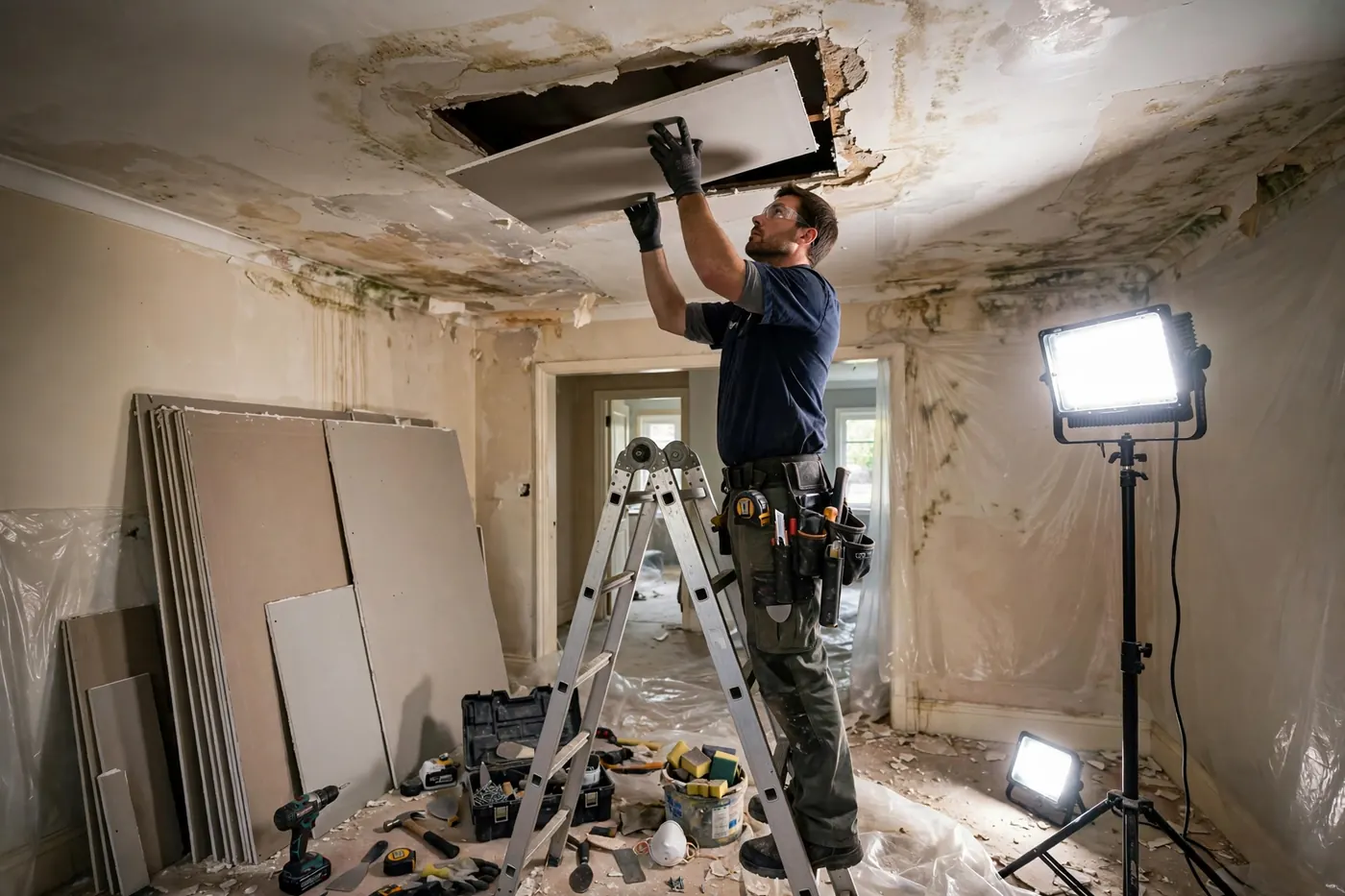
Ceiling water damage is the most common call we get in Greenville, and it almost always starts the same way: a brown stain appears, grows slowly for weeks, and then one day there’s an active drip — or a soft, bulging spot that looks ready to give way. Upstairs bathrooms are the #1 culprit (toilet valves, shower pans, tub overflows), followed by roof leaks after our big Upstate storms, and AC condensate lines that clog and overflow into the ceiling below.
Here’s what experience has taught us about Greenville ceiling leaks: the stain you see is never the whole story. Water travels along joists and drywall seams before it shows itself, so the actual leak is often feet away from the stain. And by the time a ceiling is visibly sagging, the drywall is saturated and the cavity above has been wet long enough for mold to start. Proper ceiling water damage repair means tracing the leak to its true source with moisture meters — not just painting over the stain, which is what too many handymen do.
Our process handles the full chain: we find and stop the source (plumbing repair or roof-leak coordination), extract any trapped water, dry the ceiling cavity with verified readings, remove only the drywall that’s actually ruined, treat against mold, then hang, tape, texture-match, and paint. Your ceiling comes back looking like nothing ever happened — and the leak that caused it is fixed, not hidden.
A damaged ceiling is a symptom — the cause is usually above it. Our thermal moisture inspection traces the source without tearing your home apart, and burst supply lines are the most common culprit (see burst pipe repair).
Ceiling Warning Signs You Shouldn’t Ignore
An expanding stain means active, ongoing leaking — not an old event. The water is still coming from somewhere above.
Saturated drywall loses structural strength. A bulge can hold gallons and collapse without warning — keep furniture and people clear.
Obvious, but worth saying: put a bucket under it, and if you can, shut off the nearest water source (often an upstairs bathroom valve). Then call.
Moisture pushing through from above breaks the paint bond. The leak is behind the finish, traveling inside the ceiling assembly.
If the room smells damp but the ceiling looks okay, water may be pooling in the cavity above — the worst kind, because it’s invisible until it’s bad.
What’s Included in Ceiling Repair
- Leak source tracing with moisture meters and thermal imaging
- Plumbing source repair (toilet valves, supply lines, shower/tub leaks)
- Roof-leak coordination — we handle the interior emergency and tarping guidance
- Controlled drainage of bulging ceilings (no surprise collapses)
- Water extraction from the ceiling cavity
- Structural drying with verified moisture readings before close-up
- Removal of only the unsalvageable drywall — targeted, not wholesale
- Antimicrobial mold prevention inside the cavity
- New drywall hung, taped, texture-matched, primed, and painted
- Full photo documentation for your insurance claim
How We Repair Water-Damaged Ceilings
Trace the Source
Meters and thermal imaging find where water is actually entering — often feet from the visible stain. We confirm the source before touching the ceiling.
Stop It & Drain
Plumbing repaired, or roof leak stabilized. Bulging sections drained in a controlled way so nobody gets a surprise shower of contaminated water.
Dry & Treat
Cavity dried with directed airflow and verified with meters. Antimicrobial treatment prevents the mold that loves dark, damp ceiling spaces.
Rebuild Invisible
Drywall replaced, texture matched to your existing finish (knockdown, orange peel, smooth), primed, and painted. Walk through it — you won’t find the repair.
Cost of Ceiling Water Damage Repair
What Affects the Cost?
Ceiling water damage repair in Greenville, SC typically runs $500–$1,500 for a contained single-leak repair (source fix + dry + patch + paint) and $2,000–$5,000+ when plumbing repairs, large sections, or mold remediation are involved. Painting over a stain without fixing the source costs less today and far more later.
- Source repair complexity — a toilet valve swap vs. a shower pan rebuild are very different jobs
- Ceiling area affected — a 2-foot stain vs. half the living room ceiling
- Texture matching — smooth ceilings are straightforward; heavy textures take artisan work to blend invisibly
- Mold in the cavity — discovered more often than homeowners expect; remediation adds containment and treatment
- Second-floor vs. single-story — upstairs plumbing leaks often damage two levels, not one
Insurance Claims, Simplified
Ceiling leaks from sudden plumbing failures and storm-damaged roofs are among the most routinely covered water claims we see. The key phrase adjusters look for is ‘sudden and accidental’ — a toilet supply line that let go qualifies; a roof that’s been leaking for two years usually doesn’t. We document the source and timeline to give your claim its strongest footing.
Ceiling leaks that go unnoticed are a top cause of hidden mold — the EPA’s mold resources show what to watch for.
How to Prevent It Next Time
- Replace toilet supply lines and valves every 8–10 years — they’re the #1 ceiling-leak source we see
- Re-caulk tub and shower enclosures annually; failed caulk lets water behind walls
- Have your roof inspected after major storms — small flashing failures become ceiling stains months later
- Pour a cup of vinegar down AC condensate lines yearly to prevent the clogs that flood ceilings
FAQs About Ceiling Water Damage Repair
There’s a brown stain on my ceiling but it’s dry. Do I still need to worry?
Yes — a dry stain means it leaked before and may leak again, and the cavity may still hold moisture or mold. We meter it to see what’s actually going on up there before it becomes an active problem.
My upstairs toilet leaked through to the kitchen ceiling. Can one company handle all of it?
Absolutely — this is our most common ceiling job. We repair the toilet valve or supply line, dry the ceiling cavity, replace damaged drywall, and repaint. One crew, one estimate.
The ceiling is bulging and feels soft. Is it dangerous?
It can collapse, yes — saturated drywall is heavy and weak. Don’t press on it or stand under it. We drain it in a controlled way on arrival. Call now, not tomorrow.
Can’t I just paint over the water stain?
You can, and it’ll look fine for a few months — while the leak continues rotting the framing and growing mold behind your fresh paint. We see the aftermath of ‘just paint it’ jobs regularly, and the eventual repair always costs more.
How do you match my ceiling texture?
We identify your texture type (knockdown, orange peel, smooth, etc.), practice-match it, and blend the repair across a wider area so the eye can’t find the transition. It’s craft work, and we’re particular about it.
Will my insurance cover a ceiling leak?
Sudden leaks — burst supply lines, toilet overflows, storm roof damage — are typically covered. Long-term slow leaks often aren’t, which is why calling early matters. We document everything for your adjuster.
How long does ceiling repair take?
Most single-leak ceiling jobs complete in 2—4 days: source repair and drying first, then drywall, texture, and paint. Larger or mold-involved jobs take longer — we’ll timeline it honestly after inspection.
Proudly Serving the Upstate
Greenville Spartanburg Anderson Greer Mauldin Simpsonville Fountain Inn Easley Travelers Rest Pickens
Covering 20+ ZIP codes across Greenville, Spartanburg & Anderson counties.
Stain growing? Drip starting? Call before it gets worse.
Every hour of standing water means more damage — and more cost. Call now and we dispatch immediately.